The Charleston, jokers and the card
American Mahjong
The style played in the United States with a card of hands that changes every year. Here is how to read that card, how the Charleston works, and where jokers can go.
152 tiles8 jokers9 sections on the card1 new card a year
Section 1
What makes it American
American mahjong uses the same suits, winds and dragons as every other style, then adds four things of its own and leaves one out.
The fourth is the card. Every winning hand has to match one of the hands printed on the National Mah Jongg League's card for the year, tile for tile.
Section 2
The card, line by line
The card lists the hands you are allowed to make this year, grouped into sections, with each hand on its own line.
We explain how the card works and never reprint it. The League sells it, and its terms don't allow copying its products, so the line below is invented to show the notation.
Reading one line#
an invented line, not a hand from any card
- 1 Flowers. F is a flower. Flowers, winds and zero always print in the same color, because they belong to no suit.
- 2 A number. A number means that number in any suit, not a particular one.
- 3 Dragons. D is a dragon. N, E, W and S are winds, and 0 is Soap, the White Dragon, standing in for a zero.
- 4 The colors. They say how many suits the hand uses, never which ones. One color means one suit, two colors two suits, three colors three. Same color, same suit.
- 5 X or C. X means you may expose sets as you claim them. C means the hand stays concealed until you win, though you may still claim the tile that wins it.
- 6 The value. What the hand pays. A win with no jokers pays double, except in the Singles and Pairs section.
Some lines also carry a note in parentheses. It explains what the line means, and it can override what the printed pattern would otherwise say, so read it before you commit to a hand.
The sections#
The current card groups its hands into nine sections:
- The year
- 2468
- Any Like Numbers
- Quints
- Consecutive Run
- 13579
- Winds-Dragons
- 369
- Singles and Pairs
The sections change from year to year, so an older card's list reads a little differently. Hands are named by their section and line number, which is how players tell each other what they are making.
Where jokers can go on a line#
A joker stands in only inside a group of three or more identical tiles. So a line's pungs, kongs, quints and sextets can take jokers, and its single tiles and pairs never can. The card does not mark this, so read the groups.
Turn the card over#
Rules are printed on the back, including the joker rules and a numbered list about claiming a discard. Guides cite those rules by number, so it is worth reading once.
Getting this year's card#
The new card reaches players in late March or early April, and the League's year runs to March 31, so you play the card you have until the next one arrives. Buy it from the National Mah Jongg League, whose store lists a standard card, a large print card and a bigger Mega Card.
Section 3
The Charleston
Before the first turn, players pass tiles they don't want, three at a time, in a set order.
That first round is required. A second round can follow, the same three passes in reverse: left, across, then right.
Stopping the second round#
The second round happens only if everyone wants it. Any one player can stop it, and nobody has to give a reason. Say so in the gap after the first round ends: once a player has picked up the tiles from the second round's first pass, it is too late.
The blind pass#
On the last pass of each round, the left pass of the first round and the right pass of the second, you may pass on one, two or three of the tiles you were just handed without looking at them. It is how you pass three tiles when you would rather not break up your hand.
The courtesy pass#
Last, the two players sitting across from each other may swap up to three tiles. Each pair settles its own number, and if you want three and your opposite wants one, you swap one. It can still happen when the second round was stopped.
Jokers are never passed#
No part of the Charleston may pass a joker, courtesy pass included. If one reaches you, hand it straight back.
When something goes wrong#
If the tile counts come out wrong during the Charleston, the hand is thrown in, the walls are rebuilt, and the hand starts again.
If East's first 14 tiles already make a winning hand, East declares it and there is no Charleston at all. Mahjong Time's rules differ: they have the first round played even then.
Section 4
Picking a hand
Keep more than one hand in mind, and expect the passes to change your plan.
Sort your tiles into the groups the card uses and keep several hands in mind rather than committing to one. The Charleston is the reason: the tiles you pass and receive can turn a weak start into a different hand entirely.
Section 5
Playing with five or six
With five or six players, four play each hand and the rest sit out, taking turns.
Who sits out#
To start, everyone rolls the dice, and the lowest roller sits out the first hand. When a hand ends, the player who was East gets up, and the player who was waiting takes the empty seat. With six, two players sit out, and each time East gets up, the one who has waited longer comes in.
The bettor#
If your group plays with betting, whoever is sitting out bets on each hand. Once the Charleston is over, courtesy pass included, the bettor looks at every player's tiles and privately writes down which player they think will win, or that nobody will before the wall runs out.
For the rest of the hand the bettor says nothing, not even to point out a mistake, and a comment cancels the bet.
Paying the bettor#
If the bettor's player wins, everyone who pays the winner also pays the bettor the same amount. If that player loses, the bettor pays the winner whatever that player pays: double if they threw the winning tile.
If the bettor said nobody would win and the wall runs out, each of the four players pays the bettor. The association's rulebook says the lowest value on this year's card, and Sloper's FAQ says 25 cents.
Section 6
A sheet to print
One page with the rules that come up at the table, to keep beside your rack while you learn.
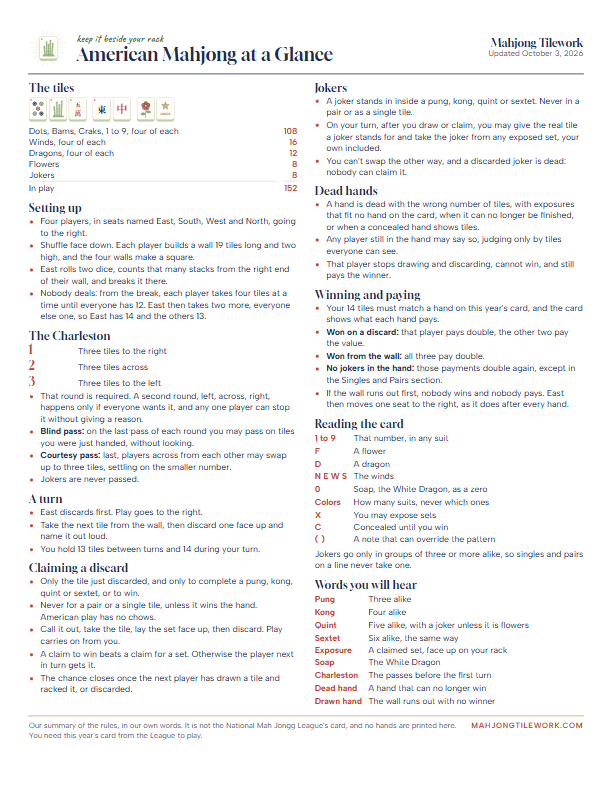
It covers the tiles, the Charleston passes, what you may claim, what jokers can do, dead hands and paying the winner, in the same words as these pages.
It is our summary, not the League's card: it has no hands on it. You will still need this year's card to play.
Section 7
The rest of the rules
Everything else about American play sits on the rules page, so it stays in one place.
- Claiming a discard: what you may call, when the chance closes, and who gets a tile two players want.
- Jokers in play: swapping a tile for a joker, and why a discarded joker is dead.
- Dead hands and mistakes: what makes a hand dead, and what a false Mahjong costs.
- Winning and paying: what the discarder pays, and the bonus for a hand with no jokers.
- Playing with two or three: the League's own adjustments, and the Siamese variant where each player runs two hands.
- Chinese and Hong Kong mahjong: no card, no jokers, no Charleston, and chows are back.
Questions about American play
What do the colors on the card mean?
They say how many suits a hand uses, never which ones. One color means one suit, two colors mean two suits, and three mean three. Tiles that belong to no suit, such as flowers, winds and zero, always print in the same color.
When does the new card come out?
In late March or early April. You play the card you have until the new one arrives, and the League's year ends on March 31.
Do you have to do the Charleston?
The first round is required. The second round is optional, and any one player can stop it without giving a reason. The courtesy pass across the table can still happen either way.
What is a blind pass?
On the last pass of each round, you may pass on one, two or three of the tiles you were just handed without looking at them. It is how you pass three tiles when you don't want to break up your hand.
Can five people play American mahjong?
Yes. Four play each hand and the fifth sits out, and after each hand the player who was East sits out next. If your group plays with betting, the player sitting out bets on the hand, collecting what the winner collects if right and paying what their chosen player pays if wrong.
Where these rules come from
We wrote this page in our own words and checked every rule against at least two published sources: Tom Sloper's mahjong FAQs, which draw on the National Mah Jongg League's rulebook, its card and its bulletins; the American Mah Jongg Association's rulebook guide; the National Mah Jongg League's own store, league page, January bulletin and site terms, and its answer on paying a bettor from a former FAQ page the Internet Archive kept; Yellow Mountain Imports' guide; Mahjong Time's American rules; and Wikipedia's article on American mahjong. Where they disagree, the page says so or leaves the rule out.
The card itself belongs to the League, and we never reproduce it. Many groups also play with table rules of their own. If yours plays a rule differently, please tell us through the contact page. Mahjong Tilework isn't affiliated with any of these sources.