Hong Kongalso called Cantonese
Among the most popular forms, and the one this page teaches in full.
- Tiles 144, or 136 with the bonus tiles left out
- In hand 13, and 14 to win
- To win four sets and a pair
- Scoring faan, each roughly doubling the payment
One name, many games
Ask for the Chinese rules and you are asking about a family of games, not one game. Here is what the name covers, and how to play Hong Kong mahjong, one of the most popular.
30+ versions in China144 tiles, or 13613 tiles in hand
New to the game? How to Play Mahjong teaches a first game in six steps, and Mahjong Rules is the reference to look things up in.
Section 1
Here are four of the styles behind the name, and they differ mainly in how a hand is scored.
Among the most popular forms, and the one this page teaches in full.
The oldest of these still being played. Its distinctive feature is that every player scores their hand at the end, not only the winner, so a hand you never completed can still be worth something.
Tournament rules, first set out in China in 1998 and used for international play.
The big departure: a longer hand, and scores that add up instead of doubling.
Beyond these are the regional games, Sichuan and Wenzhou and Fujian among many others, which change the tiles and the scoring enough to be games of their own. Mainland China alone has more than thirty versions.
So the useful question at a new table is not "do you play Chinese rules" but "which ones, and what does a hand have to be worth". The rest of this page answers it for Hong Kong play.
Section 2
Four players, 13 tiles each, and a hand of four sets and a pair that, at many tables, has to be worth a minimum score before it can win.
The game uses the 136 tiles every style shares: three suits numbered 1 to 9, four winds and three dragons, four of each. A full set adds eight bonus tiles, four flowers and four seasons, for 144. Those eight are optional, and plenty of groups leave them in the box and play with 136.
There are no jokers in Hong Kong play.
The chow is the one American players have to add back: three in a row counts as a set here, and American mahjong has none.
Draw a flower or a season and it does not stay in your hand. Set it face up beside your tiles and take a replacement from the end of the wall, and again if the replacement is another bonus tile. Each one is numbered 1 to 4 for East, South, West and North, and the one matching your seat is worth a faan at the end.
Shuffle the tiles face down and build them into four walls, one in front of each player, two tiles high. With the bonus tiles in that is 18 stacks each, and 17 without them. Push the four walls together into a square.
Dice decide where the wall is broken, and here the published rules differ: one roll or two, counted along the dealer's own wall or along somebody else's. Use whichever your table uses. The stacks to the right of the break are then set aside as the dead wall, the supply that replacement tiles come from. Fourteen is a common number to hold back, by agreement rather than by law.
From the break, and going counterclockwise, players take four tiles at a time until everyone holds 12. The dealer then takes two more and the other three take one each, so the dealer ends on 14 tiles and the others on 13. That 14th tile is dealt, not drawn, which is why the dealer's first turn is a discard and nothing else.
Before that discard, anyone dealt a flower or a season shows it, sets it aside and takes a replacement, again if the replacement is another bonus tile. Then the dealer throws a tile out and the hand is under way.
Take the next tile from the wall, then discard one face up in the middle of the table. You hold 13 tiles between turns and 14 during your own. Play moves counterclockwise, to the player on your right.
That is the whole turn. Most of what else happens in a hand comes from claiming other players' discards.
You can claim only the tile that was just discarded, and only to complete a set or to win. Call it, take the tile, lay the finished set face up, and discard. Play then carries on from you, so anyone sitting between you and the discarder loses a turn.
A chow is the one claim with a restriction: you may take a discard for a run only from the player on your left, the one whose turn comes just before yours. Pungs and kongs can be claimed from anybody.
When two players both claim the same tile to win, tables settle it in different ways, so ask before you start.
A kong is four alike, and it still counts as one set, so you are a tile short. Take a replacement from the end of the wall, then discard as usual.
You can also add a fourth tile to a pung you have already exposed, but only a tile you drew yourself, never a discard. That moment has its own rule: if the tile you are adding would finish another player's hand, they may take it and win. That is robbing the kong, and it is worth an extra faan.
Four sets and a pair, 14 tiles in all. The sets can be chows, pungs or kongs, in any mixture.
A few special hands win without that shape, thirteen orphans among them, and each table decides which of them it recognizes. That is worth asking about too, because the lists differ.
The dealer keeps the deal after winning, and usually after a drawn hand as well, so a good dealer can hold the seat for a while. Otherwise the deal passes to the right.
A full game is four rounds, named East, South, West and North, which takes at least 16 hands. If the wall runs out before anyone wins, nobody wins that hand and the tiles are shuffled again.
Section 3
A Hong Kong hand has no printed value. It scores faan for the patterns in it, and each faan roughly doubles what the winner collects.
Faan come from patterns: the flower that matches your seat, a set of the round's wind, a hand made entirely of one suit, a win by robbing a kong, and so on up to the rare hands that reach the limit in one go. Mahjong Terms defines faan and tai against the units the other styles count in.
We do not print a table of values here, and you should be careful with any that you find. Our sources disagree on nearly every number, which is a real feature of the game rather than sloppiness: Hong Kong scoring is a local agreement. Get your table's list before the first hand.
Many tables set a minimum score, and a hand worth less than it cannot be declared a winner, however complete it is. Three faan is the usual figure, though groups play higher or lower.
At the other end, a limit caps what the biggest hands pay. Tables set it themselves, often at 10 faan, sometimes as high as 13. Without it the doubling would run away with the game.
Only the winner is paid, and there are two common arrangements for who pays them. Both are widely published, so this is another thing to settle before you start.
Win on a tile you drew yourself and the question does not arise: all three players pay.
Section 4
Sitting down at a Chinese table means agreeing on five things. A table of regulars may have settled them long ago, so ask.
None of this is fussiness. These are exactly the points the published sources disagree about, which means two players who both learned "the Chinese rules" can arrive at the table with different games in mind.
Section 5
Taiwanese mahjong deals 16 tiles instead of 13, so a winning hand is five sets and a pair.
The bonus tiles are nearly always in play, so a full 144-tile set is the norm.
Scoring works differently as well. Hands are counted in tai, and tai add together rather than doubling, with many groups playing to no limit at all. The dealer collects extra for winning and keeps the deal, taking a further bonus each time it repeats. Two players can both win from the same discard. And a player holding all eight flowers and seasons wins the hand on the spot.
Taiwanese mahjong is the thinnest covered of the styles here. It has no encyclopedia article of its own, so the page keeps to points two of our sources agree on.
Section 6
One page of Hong Kong play, to keep beside the tiles while the rules are still new.
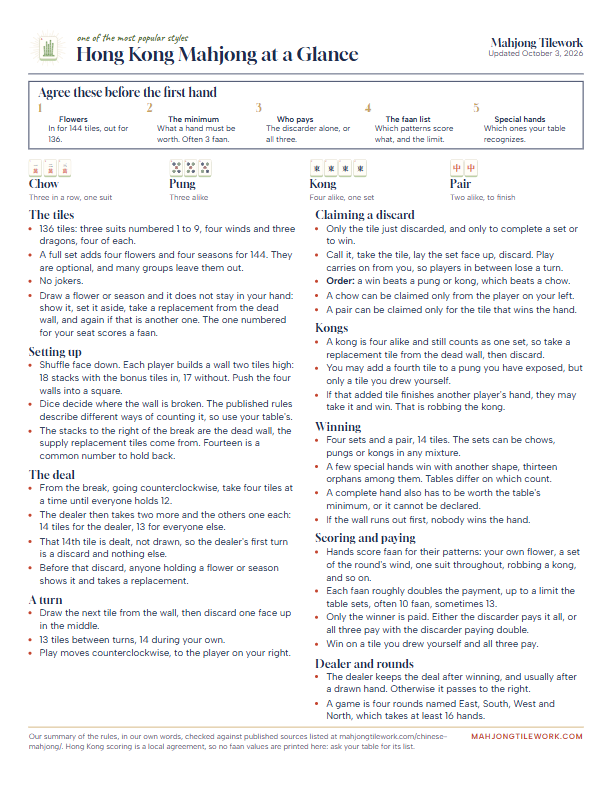
It starts with the five things to agree on before the first hand, then covers the tiles, the wall, the deal, a turn, claiming, kongs, what wins, scoring and paying, and the rounds.
It is a Hong Kong sheet, not a Chinese one, for the reason this page opens with. It carries no faan values, because those belong to your table rather than to us.
Section 7
The suits, winds and dragons are the same, and so is the turn. Five things differ, and one of them changes how the whole game feels.
The freedom is the surprise. American play hands you a menu of hands and asks you to fill one of them; Hong Kong play hands you a shape and a price, and everything else is yours to decide.
There is no single set. The Chinese styles share the same tiles and the same draw and discard turn, and most win with four sets and a pair, but they score in different ways. Hong Kong play, one of the most popular, works like this: 13 tiles in hand, four sets and a pair to win, and a minimum score the table agrees on first, often 3 faan.
Hong Kong mahjong, also called Cantonese, is one of the Chinese styles, and among the most popular of them. The others include Chinese Classical, where every player scores, the Chinese Official tournament rules, Taiwanese with its 16-tile hands, and dozens of regional games.
144 with the four flowers and four seasons, or 136 when a group leaves those out. You hold 13 tiles between turns and 14 during your turn. Taiwanese mahjong is the exception: you hold 16 and win with 17.
Faan is the unit a Hong Kong hand scores in. Each faan roughly doubles what the winner collects, up to a limit the table sets, and many tables ask for a minimum before a hand can win at all, most often 3 faan.
We wrote this page in our own words and checked every rule against at least two published sources from different publishers: Tom Sloper's FAQ pages on Hong Kong mahjong, simplified Chinese rules and comparing the styles; Wikipedia's Mahjong, Hong Kong mahjong scoring rules and Scoring in Mahjong; Mahjong Time's Hong Kong and Taiwanese rules; and Yellow Mountain Imports' guide to Chinese mahjong. Where they disagree, the page says so or leaves the rule out, which is why you will not find a table of faan values here.
These are our rules as we understand them, not anyone's standard. If your table plays a rule differently, that is the nature of this game, and we would like to hear about it through the contact page.