The rules for two
Two-Player Mahjong
Two people, one set of tiles, and two different games that share the name. Here is what each one changes, and how to tell which one someone means.
2 ways to play1 hand each, or 20 Charleston
New to the game? How to Play Mahjong teaches a first game in six steps, and American Mahjong covers the card and the Charleston.
Section 1
Which game do you mean?
The quickest way to tell them apart is to count the racks in front of each player.
| Two-handed | Siamese Mah Jongg | |
|---|---|---|
| Hands each | 1 | 2one on each rack |
| Racks each | One | Two, or one double rack |
| Tiles to start | 14 for the dealer, 13 for the other player | 27 each, and the dealer picks a 28th to begin |
| The walls | All four are built, as with four players | Two walls in front of each player |
| The Charleston | None | None |
| How you win | Complete a hand on the card | Complete both of your hands |
| Whose rules | The National Mah Jongg League's rulebook | Gladys Grad's. She publishes them and sells a card for them |
Everything else is the American game you already know, with the same 152 tiles. The two-handed game keeps the card and every rule of play; Siamese changes a few, set out in section 3, and can be played with its own card.
Section 2
Two-handed, the League's way
Two players sit across from each other and play one hand each, exactly as they would in a four-player game, minus the Charleston.
The deal#
Only the two of you take tiles, four at a time, until you each hold 12. The dealer then takes two more and the other player one, so the dealer has 14 tiles and the other player 13, the same counts as a four-player game.
No Charleston#
Skip it. The dealer opens by discarding, and play goes back and forth from there.
Everything else is the usual game#
Your hand still has to match one on this year's card. You still claim discards for a set or to win, swap tiles for jokers, and pay the same amounts. East still moves on after every hand, which with two players means the two of you take turns dealing.
These rules come from the League's own rulebook, which it sells alongside the card.
Section 3
Siamese Mah Jongg
In Siamese Mah Jongg, each player runs two hands at once, on two racks, and wins by completing both.
It is a variant by the teacher Gladys Grad, who publishes its full rules and sells a card of hands for it. What follows is the shape of the game in our words. Her rules carry the rest, including the penalties, tournament play, and the Royale version for three and four players.
Setting up#
The two players face each other, each with two racks, or one double rack. Each player builds two walls, 19 tiles long and two tiles high, one in front of each rack. The dealer throws one die to break their own first wall, and both of the dealer's walls are used up before the opponent's.
Her rules allow playing without walls, from a shuffled pool of face-down tiles, only as a social game. Walls are required for tournament play.
Why guides say 27 and 28#
Each player takes 27 tiles, the same number for both, which is deliberate: it takes away the extra tile the dealer normally enjoys. The dealer then picks a 28th tile to start the game and discards, exactly as a player does on any turn. That is why guides describe the deal as 27 and 28.
There is no Charleston, and no courtesy pass.
Playing two hands#
You may move tiles freely between your own two racks while they are still in your hand, so the two hands support each other. Once tiles are exposed on a rack, they belong to that hand and stay there.
You win when you have declared both of your hands. The game also ends if the tiles run out first, which is a drawn hand.
Jokers, and when to show a finished hand#
Jokers can be taken from anyone's exposed sets, your own included, but never out of a hand that has been declared and exposed as a winner. That gives you a choice worth thinking about: showing your first finished hand protects its jokers, while holding it back keeps those jokers available to you a little longer.
What hands pay#
Your first hand pays the value printed on the card you are using, and a hand with no jokers pays double, as in the four-player game. The second hand, the one that wins the game, pays double, and doubles again if it has no jokers. Feeding your opponent the tile that finishes their second hand costs you points, and a drawn hand pays both players a small amount.
Her rules set out the exact amounts, along with the penalties for a wrong count of tiles, a misnamed discard or a mahjong called in error.
Section 4
If you have three players
Three is the easier fix, and the League's rulebook adjusts for it too.
Build all four walls and deal nothing to the empty seat. Each player takes four tiles at a time until everyone holds 12, then the last tiles go out so that the dealer has 14 and the others 13. Skip the Charleston, and the dealer opens by discarding.
Sources differ on exactly how those last tiles are handed out, and Sloper's FAQ lists three ways the League itself has printed. Pick one before you start and keep it for the session.
Section 5
A sheet to print
One page with both games on it, to keep beside the racks while you learn.
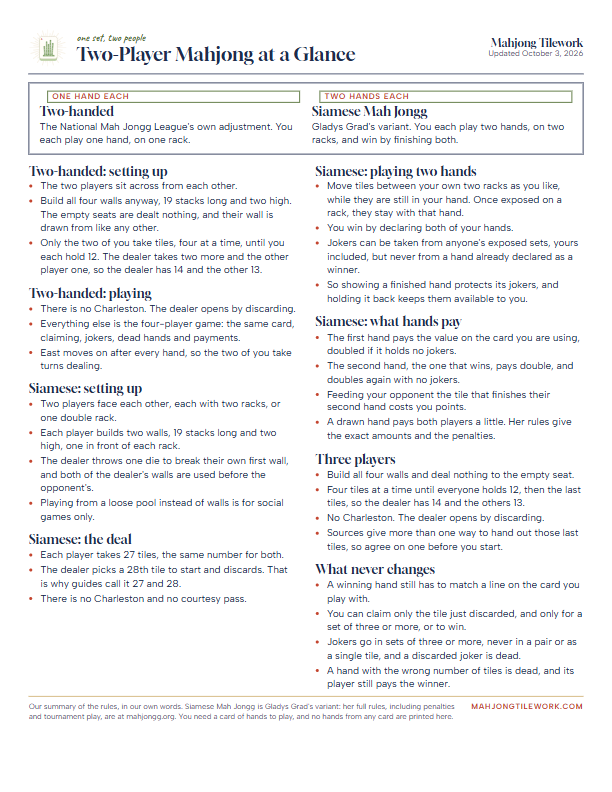
It covers the two-handed setup and deal, the Siamese setup, deal, two hands and scoring, the three-player adjustment, and the rules that never change.
It is our summary, not the League's card and not a replacement for Gladys Grad's Siamese rules. You will still need a card of hands to play.
Section 6
What doesn't change
In the League's games for two and three, the rest of the game is unchanged.
- The card: your hand still has to match a line on it, and the notation works the same way.
- Claiming a discard: still only the latest one, and only for a set or to win.
- Jokers: the same limits, and the same swap on your turn.
- Winning and paying: the same values, doubles and dead hands.
Questions about playing with two
What is two-player mahjong called?
Two different games share the name. Two-handed mahjong is the National Mah Jongg League's own adjustment, where you each play one hand. Siamese Mah Jongg is Gladys Grad's variant, where you each play two hands on two racks.
Is there a Charleston with two players?
No, in both methods. The League's two-handed adjustment skips it and starts with the dealer's first discard, and the Siamese rules have no Charleston and no courtesy pass.
Can you play Chinese mahjong with two people?
Tom Sloper describes one adaptation: deal to the two seats facing each other, leave the flowers out, and claim no chows. Our other Chinese and Hong Kong sources describe a game for four and give no rules for two.
Is two-player mahjong real mahjong?
Guides differ. Yellow Mountain and Mahjong Time describe a game for four, while Wikipedia's article opens by calling it a game for two to four, and the League's own rulebook includes adjustments for two or three players.
Where these rules come from
We wrote this page in our own words and checked every rule against at least two published sources: Tom Sloper's FAQ on playing with fewer than four, which cites the National Mah Jongg League's rulebook for the two-handed and three-handed rules; the American Mah Jongg Association's guide to two-handed and three-handed play; and, for Siamese Mah Jongg, Gladys Grad's own rules, read alongside the guides published by the shop Southern Sparrow. Where they disagree, the page says so or leaves the rule out.
Siamese Mah Jongg is Gladys Grad's variant, and this page is a description of it, not a substitute for her rules. Mahjong Tilework isn't affiliated with her, with the League, or with any other source here. If your group plays a rule differently, please tell us through the contact page.