The words at the table
Mahjong Terms
Mahjong borrowed its vocabulary from three languages and never tidied up. Here is what each word means, and which style it belongs to.
Untagged words belong to every style unless the entry names one. Otherwise: American Hong Kong Chinese Official Japanese
New to the game? How to Play Mahjong teaches a first game in six steps, and Mahjong Rules is the reference to look a rule up in.
Section 1
The tiles
Every style plays with the same three suits, four winds and three dragons, and then adds different extras to them.
- Bams
- One of the three suits, numbered 1 to 9, also called bamboo. The bumps are coins on a string, not knots in a cane. Every Mahjong Tile, Named
- Blank
- A spare tile, for replacing one you lose or chip. On older sets four of the blanks are the White Dragons.
- Bonus tile Hong Kong Chinese Official
- A flower or season: set aside when drawn rather than played, and replaced from the wall.
- Craks
- The character suit, 1 to 9. The lower character on all nine, 萬, means ten thousand. Every Mahjong Tile, Named
- Dots
- The coin suit, 1 to 9, also called circles.
- Dragons
- The red, green and white honor tiles. Wikipedia's article on the tiles gives their Chinese name as the three fundamental tiles, and credits the English name to Babcock. Every Mahjong Tile, Named
- Flower, season American Hong Kong Chinese Official
- Eight tiles, numbered 1 to 4 for the four seats. Hong Kong and Chinese Official play set them aside as bonus tiles; American play uses them in hands, all eight as one interchangeable tile. Japanese play leaves them out.
- Honor
- Any wind or dragon, as opposed to a numbered suit tile.
- Index
- The Arabic numeral or Roman letter printed in the corner of an export tile. Sets made for China, Hong Kong and Japan usually carry none. Every Mahjong Tile, Named
- Joker American
- A wild tile, eight to a set. It can stand in inside any group of three or more alike, and never in a pair or as a single tile. Mahjong Rules
- Red five Japanese
- One five per suit printed in red, counting as dora. Common in Japanese sets, and dropped by the European competition rules.
- Simple Japanese
- Any numbered tile from 2 to 8: not a terminal, not an honor.
- Soap American
- The White Dragon, used as a zero in hands that need one, such as a hand spelling out a year. Every Mahjong Tile, Named
- Terminal
- A 1 or a 9 of any suit. A hand of terminals alone pays the limit in Hong Kong and Japanese play; let the honors in as well and it pays very little. All Terminals
Section 2
The table
The furniture of a game: what the tiles sit on, where they come from, and what the seats are called.
- Dead wall Hong Kong Japanese
- Tiles set aside at the end of the wall and not drawn from in the ordinary way. Hong Kong play takes its replacement tiles from here; Japanese play keeps it at fourteen and turns its dora indicators up in it. Japanese Mahjong
- Pusher American
- The long bar that shoves your wall forward into reach. Usually sold with the racks. Buying Your First Mahjong Set
- Rack
- The stand that holds your tiles upright in front of you. American sets include four; Chinese and Japanese sets usually include none, because those tiles stand on end unaided.
- Replacement tile Hong Kong Chinese Official Japanese
- The tile you take from the end of the wall after declaring a kong or setting a bonus tile aside. American play has none.
- Round wind, seat wind Hong Kong Japanese
- The wind of the round, and the wind of your own seat. A set of either scores where an ordinary wind does not.
- Wall
- The face-down tiles every hand is drawn from, built in four lines and pushed into a square. In American play each line is 19 tiles long and two high. How to Play Mahjong
- Wind indicator
- The small block that shows whose round it is. Some sets include one, some do not.
Section 3
Making a hand
The groups you build from, and the words for what happens to them.
- Chow Hong Kong Chinese Official Japanese
- Three tiles in a row in one suit. It can be claimed only from the player on your left. American play has no chows at all. Mahjong Rules
- Concealed, exposed
- A concealed hand is one you have claimed no discard into. Exposing a set means laying it face up where everyone can see it, which is what claiming a discard costs you. Four Concealed Pungs
- Dead hand American
- A hand that can no longer win, for instance because it holds the wrong number of tiles. Its player stops drawing and discarding, and still pays the winner. Mahjong Rules
- Kong
- Four identical tiles, still counted as one set. In Hong Kong and Japanese play that leaves you a tile short, so you take a replacement tile; American play takes none.
- Pair
- Two identical tiles. A discard can be claimed for a pair only when it wins you the hand.
- Pung
- Three identical tiles.
- Quint, sextet American
- Five and six alike. A set holds only four of any numbered tile, wind or dragon, so a quint or sextet of those needs jokers.
- Robbing the kong Hong Kong
- Winning on the fourth tile as another player adds it to an exposed pung.
Section 4
American play
The words you will only hear at an American table, where the hands come from a card that changes every year.
- Bettor American
- In a game of five or six, a player sitting out who bets on which player will win the hand, then collects or pays along with that player. The bettor looks at every hand after the Charleston and says nothing during play. American Mahjong
- Blind pass American
- Passing on tiles you were just handed without looking at them, allowed on the last pass of each Charleston round. American Mahjong
- The card American
- The National Mah Jongg League's yearly list of the hands you are allowed to make. It changes every spring, and the game cannot be played without the current one. American Mahjong
- Charleston American
- The passing of unwanted tiles, three at a time, before the first turn: right, across, then left, with an optional second round the other way. American Mahjong
- Courtesy pass American
- The last exchange, in which the two players sitting opposite may swap up to three tiles.
- Siamese Mah Jongg American
- Gladys Grad's variant for two players, in which each of you runs two hands at once and wins by completing both. Two-Player Mahjong
Section 5
Scoring, by style
Four styles, four vocabularies, and no two of them counting the same thing.
- Dora, ura dora Japanese
- Bonus tiles marked by an indicator turned up in the dead wall. Each one in your hand adds a han, and none of them is ever a yaku. Ura dora are read from underneath the indicators, and only a riichi winner turns them over. Japanese Mahjong
- Faan Hong Kong
- The Hong Kong scoring unit. Each faan roughly doubles what the winner is paid, up to a limit the table sets. Chinese Mahjong
- Fu Japanese
- Minipoints, counted from how a hand is built rather than what patterns it holds. They stop mattering once a hand reaches five han.
- Furiten Japanese
- Barred from winning on a discard, because a tile that would complete your hand is already in your own discards. You can still win on a tile you draw yourself. Japanese Mahjong
- Han Japanese
- The doubles a Japanese hand scores, counted from its yaku and its dora.
- Ippatsu Japanese
- An extra han for winning within the first go-round after declaring riichi. Any claim or kong cancels it.
- Limit hand Hong Kong Japanese
- A hand that pays a fixed maximum, however its parts add up. Hong Kong tables set their own limit; Japanese play names several, from mangan up to yakuman. Named Hands
- Mangan, haneman, baiman, sanbaiman Japanese
- The Japanese limit hands in order, starting at five han. Above them sit the yakuman. Japanese Mahjong
- MCR, Guobiao Chinese Official
- Two names for the Chinese Official tournament rules, first set out in China in 1998. A hand must be worth at least 8 points to win. Chinese Mahjong
- Riichi Japanese
- Declaring that your concealed hand is one tile from winning, for a 1,000 point stick. The hand is locked from that moment, and the declaration is itself worth a han. Japanese Mahjong
- Tai
- The Taiwanese scoring unit. Unlike faan, tai add together rather than doubling, and many groups play to no limit at all. Chinese Mahjong
- Tsumo Japanese
- Winning on a tile you drew yourself rather than on somebody's discard. All three opponents pay a share.
- Yaku Japanese
- A named scoring pattern. A Japanese hand cannot be declared a win without at least one, however complete it is. Japanese Mahjong
- Yakuman Japanese
- The great hands, scored as a limit in their own right rather than by counting han at all.
Section 6
Names that cause trouble
Three words that mean different things depending on who is speaking, and are worth pinning down before money is involved.
- Orphans
- Three different hands answer to it. Wikipedia's article on Hong Kong scoring uses plain Orphans for a hand of ones and nines and Mixed Orphans when honors join them, while everywhere else it means the thirteen-tile hand. Named Hands
- Mahjong
- The game, the call you make on winning, and the winning hand itself. The name means sparrow, though our sources disagree about whether the bird on the 1 Bam has anything to do with it.
- The same hand, three names
- English took the vocabulary from Chinese and from Japanese separately. One hand is All Terminals and Honors, Mixed Orphans or honroutou depending on the book. Named Hands
A sheet to print
The same words on one page, for the table where the arguments actually happen.
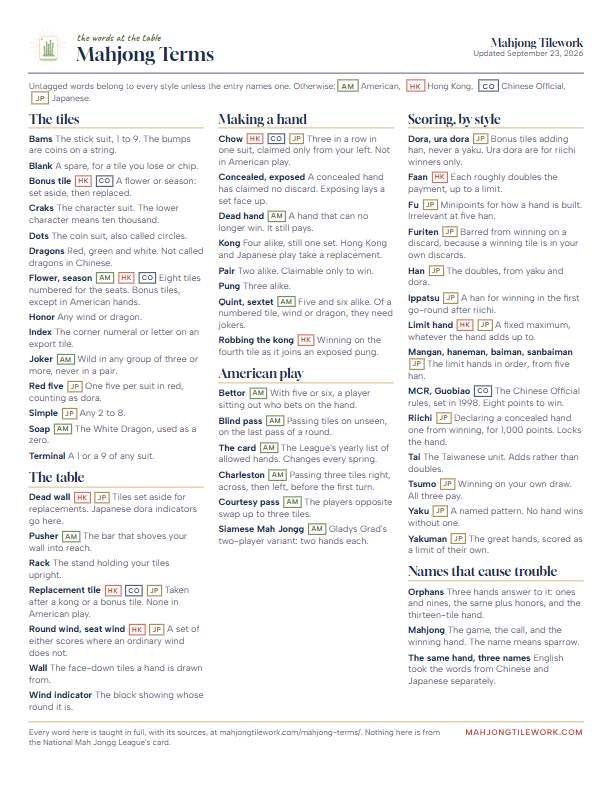
Every term here, grouped the same way and tagged with the same styles, short enough to scan while somebody waits for you to discard.
The sheet and this page are kept in step deliberately: our build refuses to publish them if the two ever list different words.
Questions about the words
What is a pung in mahjong?
Three identical tiles. A kong is four of them, and a chow is three in a row in one suit. Pungs and kongs are used in every style; chows are used everywhere except American mahjong.
What is the difference between faan, tai, han and fu?
They are four different scoring units from three styles. Faan are Hong Kong, and each roughly doubles the payment. Tai are Taiwanese, and they add together instead. Han and fu are both Japanese: han are the doubles, fu the minipoints for how the hand is built.
What does Soap mean in mahjong?
The White Dragon, as American players call it, used as a zero in hands that need one.
Why do mahjong terms have so many spellings?
Because they reached English separately, from Chinese and from Japanese. One hand can be All Terminals and Honors, Mixed Orphans or honroutou depending on which book you read.
Where this comes from
This page adds no rules of its own. Every entry is the short form of something one of our other pages teaches in full, and those pages carry the sources: the rules reference, American Mahjong, Chinese Mahjong, Japanese Mahjong, Every Mahjong Tile, Named, Named Hands, Buying Your First Mahjong Set and Two-Player Mahjong. A word we could not check on one of those pages is not here at all, which is why you will not find every term you have heard.