What the bumps are
They are coins on a string, not knots in a bamboo cane. Wikipedia's article on the tiles says the bamboo reading was Joseph Babcock's mistake, and the English name of the suit came from it.
Every tile, named
All of them drawn, all of them explained: the three suits, the winds and dragons, what the characters actually say, and the tiles that only some sets carry.
136 tiles every style shares34 different kinds4 of each
Thirty-four different tiles, four copies of each, and a handful of extras that depend on where the set was made and which game you play.
The counts are the easy part. Knowing what the tiles are pictures of is what makes the set stop looking arbitrary.
Dots are coins, Bams are strings of a hundred coins, and Craks count in ten thousands.
A dot tile shows coins. A bam tile shows a string of a hundred of them, drawn as a line of coins on a cord. And a crak counts in myriads: the character at the bottom of all nine, 萬, means ten thousand.
So each suit is worth a hundred times the one before it. It also leaves one thing worth unlearning:
They are coins on a string, not knots in a bamboo cane. Wikipedia's article on the tiles says the bamboo reading was Joseph Babcock's mistake, and the English name of the suit came from it.
None of our sources can say. The earliest sets drew it as one bent string of cash with a red knot, and Tom Sloper dates the change to somewhere between 1873 and 1890.
The game's name means sparrow, and Wikipedia's article on the tiles says the 1 Bam bird is often called the sparrow because of it. Sloper says flatly that the two are not connected. We have no way to settle that, so we leave it open.
Four winds carry the compass points, and the three tiles English calls dragons go by another name in Chinese.
The winds are straightforward: 東 east, 南 south, 西 west, 北 north. They matter because the seats are named for them, and because in Hong Kong and Japanese play a set of your own seat wind or the round wind scores, where the other winds do not. Chinese seating runs east, south, west, north, which is the order the game moves in; the American card writes them N, E, W, S.
The dragons are the interesting ones. Wikipedia's article gives their Chinese name as the three fundamental tiles, and credits the English "dragons" to Babcock, the same man who mistook the coins for bamboo. What the tiles actually carry is:
Our sources give two reasons for the border.
The white dragon began as a blank tile, and a box of tiles also contains blank spares for replacing anything you lose. Wikipedia's article on the tiles says the border is there to tell the dragon from those spares. Sloper tells the older story: on tiles with bone on one side and bamboo on the other, a blank face could not be mistaken for the back, but on plastic tiles with no colored back it could, so players kept turning the tile over to check, and showed the table it was a white dragon. Either way, the border lets the tile be read without touching it.
American players call this tile Soap, and use it as a zero in hands that need one, such as a hand spelling out a year.
Eight bonus tiles, in two sets of four, numbered to match the four seats.
The Four Gentlemen are plum, orchid, chrysanthemum and bamboo. The Four Seasons are spring, summer, autumn and winter. Each tile carries a number from 1 to 4, and those numbers belong to the seats in order: 1 is East, 2 is South, 3 is West, 4 is North. Drawing the one that matches your seat is worth something in most Chinese and Hong Kong scoring.
The artwork is not standardized at all. Two sets from different makers can draw the same winter tile so differently that they share nothing but the number, and Sloper's flower page gives more than one tradition for which flower belongs to which season, so we do not map them onto each other here.
American sets print a different four entirely, because they descend from an older Chinese pattern: Fortune, Prosperity, Longevity and Nobility. It makes no difference to play, because American mahjong treats all eight bonus tiles as one interchangeable tile called a flower, and the numbers on them mean nothing in that game.
Only sets made for export carry Arabic numerals and Roman letters.
American sets are fully indexed: every crak has a number in the corner, every wind has its letter, every dragon has a letter. Sets made for China, Hong Kong and Japan usually have none of that.
The indices arrived with the export trade, not with the game. If you are looking at an unindexed set, this is all you need:
If nobody at your table reads the characters, that is worth knowing before you buy: our guide to buying a set treats it as one of the things to check.
Some tiles come and go depending on the set and the style.
Eight in an American set, where they are essential. None in a standard Chinese set, though some Chinese and Southeast Asian sets carry four.
Spares, for replacing a tile you lose or chip. On older sets four of them are the white dragons.
A Japanese feature: one five in each suit printed in red, worth an extra han. Common in Japanese sets, though the European competition rules have dropped them.
Animals, faces, emperors, and northern sets with twenty or more flowers. Real, but far outside what a standard set holds.
Every tile on one page with its name, to keep beside the box until the names come without thinking.
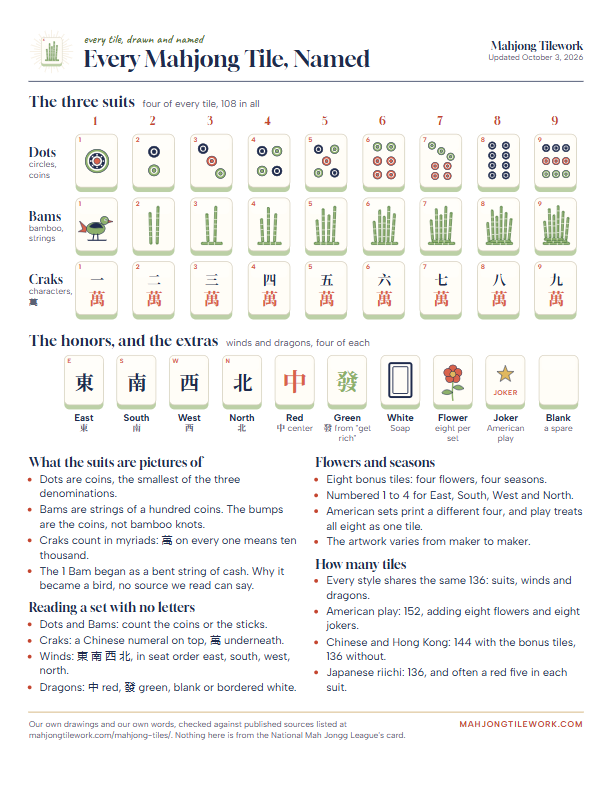
The three suits in rows of nine, the winds and dragons with their characters, and the extras a set may or may not hold, with short notes on what each suit is a picture of and how to read a set with no letters on it.
Our own drawings and our own words, from the sources at the foot of this page. It carries no scoring and nothing from the League's card.
Every style starts from the same 136 and adds different things to it.
| Style | Tiles in play |
|---|---|
| American | 152 |
| Chinese and Hong Kong | 144, or 136 |
| Japanese riichi | 136 |
American play adds eight flowers and eight jokers to the 136. Chinese and Hong Kong play adds the eight bonus tiles, or leaves them out. Japanese riichi uses the 136 alone. The rules page compares the styles in full, and the set guide explains why a box may hold 166 tiles when the game only uses 152.
Three suits, Dots, Bams and Craks, each numbered 1 to 9. Four winds, East, South, West and North. Three dragons, red, green and white. Chinese and American sets add eight bonus tiles, the flowers and seasons, and American sets add eight jokers as well.
It means myriad, or ten thousand. The suit counts money: dots are coins, bams are strings of a hundred coins, and craks count in ten thousands, which is why the same character sits on all nine of them.
None of our sources can say. The earliest sets drew it as a single bent string of cash with a red knot, and the bird arrived later. Tom Sloper guesses that a carver gave the odd tile out the elaborate treatment the ace of spades gets in a deck of cards, and says plainly that is as far as he can take it.
It began as a genuinely blank tile. Wikipedia's article on the tiles says modern sets print a border on it to tell it from the spare blank tiles in the same box. Tom Sloper adds that on plastic tiles a blank face looked like the back, so players kept turning it over to check, which gave it away.
Checked against Wikipedia's Mahjong tiles article and Tom Sloper's FAQ pages on types of sets, unusual tiles and flower tiles, alongside the sources already listed on our rules page. Where the two disagree, this page says so: the sparrow and the meaning of 發 are both left open on purpose.