Fewer tiles in play136 tiles
No flowers, no seasons and no jokers: the game uses only the 136 tiles every style shares.
Riichi, and what it costs
The Japanese game keeps the tiles and the turn you already know, then adds one rule the rest of the game is built around: a finished hand is not allowed to win unless it is worth something.
136 tiles, no flowers1 yaku to win at all5 han for a mangan
New to the game? How to Play Mahjong teaches a first game in six steps, and Mahjong Rules is the reference to look things up in.
Section 1
The suits, winds and dragons, the wall, the draw and the discard are all the same. Five things are different, and each one changes how you play a hand.
No flowers, no seasons and no jokers: the game uses only the 136 tiles every style shares.
Four sets and a pair is not enough. Section 2 is about this, because it is the rule everything else grows out of.
Several of the best yaku are only available to a hand nobody has claimed a tile into. Calling a discard is a real decision rather than a free gain.
A tile turned face up in the dead wall points at whichever tile is dora for that hand. Hold dora and every one adds to your score, but they will not let a worthless hand win.
Players start with a bank of points and move them back and forth over a game of east and south rounds, so the question is never just who won the hand.
The tiles themselves are the ones on our tile reference, with one Japanese habit worth knowing: many sets print one five in each suit in red, and a red five counts as dora. The European competition rules have dropped them, so ask before you count them.
Section 2
A winning hand has to be complete and it has to contain at least one yaku, a named pattern from the published list.
Yaku are patterns like all simples, one suit throughout, all triplets, or a triplet of dragons. Each is worth a number of han, and a hand can hold several at once. What matters first is not their values but the bare requirement: without one, a hand that is four sets and a pair is not a win.
Dora add han, sometimes a great many of them, but they are not yaku. A hand carrying four dora and no pattern is worth nothing, because it cannot be declared a win in the first place.
It makes you decide what you are building before you are close to finished. At a Hong Kong table with no minimum score, you can gather any four sets and a pair and settle the value afterwards. Here, a player who claims tiles freely can arrive at fourteen tiles that fit together perfectly and still have no hand, so every claim has to be weighed against the patterns it would cost.
It also explains the declaration the style is named for, which is the most direct way of guaranteeing yourself a yaku.
Section 3
Declare riichi and you announce that your concealed hand is one tile from finished, pay a 1,000 point stick for saying so, and give up the right to change the hand.
Two things. Your hand must be one tile from winning, and it must be concealed, meaning you have never claimed another player's discard into it. There is also a point near the end of the wall past which you may no longer declare, so it is not a decision you can leave indefinitely.
You call riichi, discard, and put the stick out. The European rulebook has the declaring player turn that discard sideways in front of them, which leaves a permanent mark of the turn the declaration was made on.
The 1,000 points, and your freedom. The hand is locked from that moment, so every tile you draw is discarded unless it wins or makes a concealed kong that leaves your wait unchanged. If a safer tile comes along you cannot keep it.
Under the European rules you get the stick back by winning, and if somebody else wins they take it. After a drawn hand it stays on the table for whoever wins next.
Riichi is itself a yaku, worth one han, which is the whole point: a hand with nothing else in it becomes a hand that is allowed to win. Two more scoring chances come with it.
The declaration is public, and that is the trade. Everyone at the table now knows your hand is one tile from finished, so you have bought scoring at the price of surprise.
Section 4
If a tile that would complete your hand is already in your own discards, you may not win on anybody else's discard.
You can still win on a tile you draw yourself, so the hand is not dead. But the fastest way to finish it has been closed off by your own earlier play, and nothing announces it: you have to notice.
A hand waiting on three different tiles is furiten if any one of the three has been discarded by you, not only the one you would rather win on. A wide wait gives you more tiles to win on, and it is also easier to spoil this way.
While your hand is still free you can change what you are waiting on and the problem goes away. After declaring riichi you cannot, so the check belongs before the declaration, not after.
Let a discard go by that would have completed your hand, whether you meant to or missed it, and you are furiten from that moment. Ordinarily it lifts as soon as you draw again.
After a riichi declaration it does not lift. Miss a winning discard then, and you are furiten for the rest of the hand, holding a locked hand that can now only win on a tile you draw yourself.
Section 5
A Japanese hand is scored with two numbers: han, the doubles, and fu, the minipoints for how the hand is put together.
Add up the han of every yaku in the hand, then add one for each dora you hold. Each han roughly doubles what the hand pays, which is why the numbers climb so quickly at the top.
Fu come from the shape of the hand rather than its patterns. There is a base amount, then more for triplets and kongs, with concealed ones worth more than claimed ones and terminals and honors worth more than simples. A few more come from certain pairs, from an awkward wait, and from winning on your own draw. The total is rounded up to the next ten.
Once a hand reaches five han, stop counting fu. They no longer affect anything.
Above a certain point the doubling stops and the hand pays a fixed amount instead. These are the names you will hear called across the table.
| Limit | Han | To a non-dealer | To the dealer |
|---|---|---|---|
| Mangan | 5 | 8,000 | 12,000 |
| Haneman | 6 or 7 | 12,000 | 18,000 |
| Baiman | 8 to 10 | 16,000 | 24,000 |
| Sanbaiman | 11 or 12 | 24,000 | 36,000 |
| Yakuman | a yakuman hand | 32,000 | 48,000 |
What thirteen han or more pays depends on the rulebook; section 7 has both answers.
Yakuman are the great hands, scored as a limit in their own right rather than by counting han at all. Nine of them have pages here: thirteen orphans, nine gates, big four winds, little four winds, big three dragons, all honors, all terminals, all green and four concealed pungs.
Some rules also round a hand that falls just short up to a mangan. Where the line sits is one of the things our sources disagree about, so it is worth asking.
Win on somebody's discard and that player pays the whole hand alone. Win on a tile you drew yourself and all three opponents pay a share, and whichever of them is the dealer pays double. Winning as the dealer is worth more too, which is the last column above.
If the wall runs out, the players who were one tile from winning are paid by the players who were not, 3,000 points in all, divided by how many of each there were. If all four were ready, or none of them were, nothing changes hands.
In American play a drawn hand costs nothing. Here, being caught with a hand you never developed is a small fine.
Section 6
The published lists are long. These thirteen are a starting set, and both our detailed sources agree on what each is worth.
| Yaku | What it is | Han |
|---|---|---|
| Riichi | A concealed hand declared one tile from winning | 1 |
| Ippatsu | Winning in the first go-round after declaring riichi | 1 |
| Menzen tsumo | Winning on your own draw with a concealed hand | 1 |
| Pinfu | Concealed, four runs, a worthless pair, waiting on two ends | 1 |
| Tanyao | No terminals and no honors anywhere in the hand | 1 |
| Yakuhai | A triplet of dragons, your seat wind or the round wind | 1 each |
| Sanshoku | The same run in all three suits | 2, or 1 if open |
| Ittsu | 1 to 9 of one suit, as three runs | 2, or 1 if open |
| Chanta | Every set holds a terminal or an honor | 2, or 1 if open |
| Chiitoitsu | Seven pairs, concealed only | 2 |
| Toitoi | All triplets, no runs | 2 |
| Honitsu | One suit plus honors | 3, or 2 if open |
| Chinitsu | One suit and nothing else | 6, or 5 if open |
The pattern in the right hand column is the shape of the whole game: concealing a hand is worth an extra han on most yaku that can be made either way. Our named hands pages cover the yakuman, and seven pairs has the chiitoitsu hand in full.
A longer list is easy to find; check its values against your rulebook.
Section 7
Riichi has no single authority. Leagues, clubs and tournament bodies each publish their own rulebook, and they do not agree, so these are the things to settle before the first hand.
None of this makes riichi a vague game. Any one rulebook is exact; there is simply more than one of them, which is why a page like this says which rulebook a number came from rather than calling it the rule.
Section 8
One page of riichi, to keep beside the tiles until the vocabulary stops being a wall.
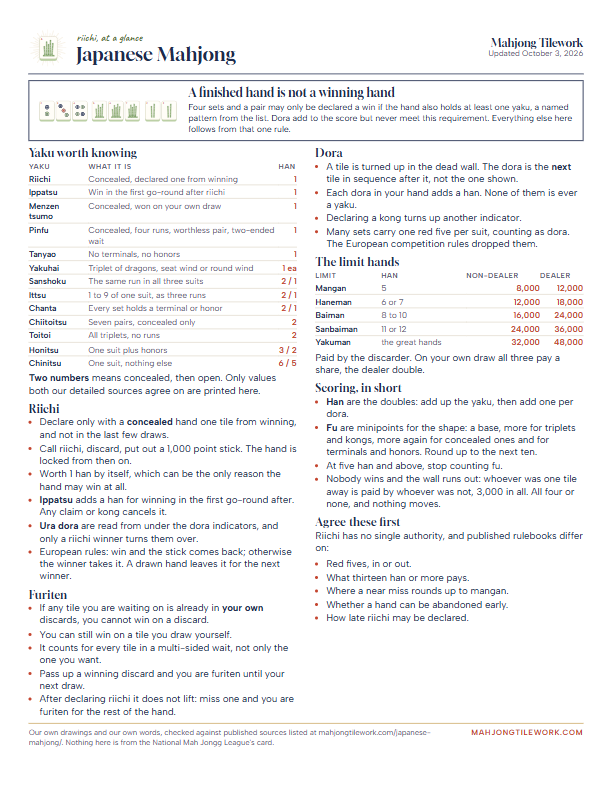
It carries the yaku table with its han, the limit hands and what they pay, and short notes on the yaku requirement, riichi, furiten and dora, in the same words as this page.
Where the rulebooks disagree, the sheet says so rather than picking one. The scoring tables themselves are not on it: they run to hundreds of cells, and your rulebook has them.
If you came here from another style, the rules page compares all four side by side, and Chinese mahjong is the closer relative: same hand, same turn, and a simpler scoring system. If it is the vocabulary slowing you down rather than the rules, Mahjong Terms collects every word on this page in one list.
The Japanese style, named after its best known rule. A player whose concealed hand is one tile from winning may declare riichi, pay a 1,000 point stick and lock the hand as it stands, in exchange for extra scoring. Japanese play uses 136 tiles, with no flowers and no jokers.
Because a hand also needs a yaku, one of the named scoring patterns. Four sets and a pair thrown together with nothing else in them cannot be declared a win. Dora, the bonus tiles, add to the score but never satisfy this requirement on their own.
You are furiten when a tile that would complete your hand is already sitting in your own discards. While that is true you cannot win on another player's discard, though you can still win on a tile you draw yourself.
The two numbers a Japanese hand scores with. Han are the doubles, counted from the hand's yaku and its dora. Fu are minipoints for how the hand is built, from its triplets, its pair and the way it was waiting. Once a hand reaches five han the fu stop mattering.
The first of the limit hands, reached at five han. Above it come haneman, baiman and sanbaiman, and above those yakuman, the hands that score the maximum outright. A mangan pays 8,000 points from a discarder to a non-dealer, or 12,000 to the dealer.
Checked against Wikipedia's Japanese mahjong and Japanese mahjong scoring rules articles, Tom Sloper's FAQ on Japanese mahjong, and the European Mahjong Association's own riichi rulebook, which Mahjong Time also republishes. Nothing here comes from riichi.wiki or the World Riichi Championship, which we were not able to read. Section 7 lists what the sources disagree about, and no number on this page rests on one of them alone.